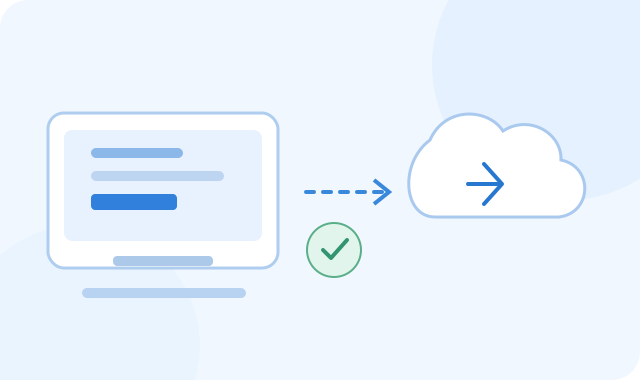
The privacy decision happens before the first black bar
Suppose a legal team wants to remove names, phone numbers and tax IDs from a contract before asking an AI service to summarize it. With an online redaction tool, the team first uploads the unredacted contract to the redaction provider. The file may be protected by the provider’s controls, but the disclosure has already happened. With an offline tool that processes the document entirely on the device, the team can prepare and inspect a new copy before deciding whether to send it anywhere.
This distinction matters most when the original contains information the redaction service did not need to receive: client records, patient details, employee files, financial statements or confidential legal material. “Redact before sharing” is most useful when the redaction step itself does not require the upload you were trying to avoid.
What is online redaction?
An online redaction service receives the source through a website or connected application, processes it on remote systems and returns a preview or downloadable copy. Some services add collaboration, central administration, audit records or approved enterprise contracts. Those may be valuable in an organization that has assessed the provider and authorized the workflow.
The privacy questions are concrete: which version travels to the provider, where is it processed, who can access it, how long are source and output retained, and can the provider use subcontractors? A lock icon or the word “secure” does not answer those questions. Encryption in transit protects the transfer, but the provider may still need access to the document to perform redaction. Read the terms for the specific service and plan.
What is offline redaction?
Offline redaction processes supported content on your computer without uploading the source for detection, review or export. A person selects one file or a batch, reviews proposed sensitive information, corrects misses and false matches, then saves a separate copy locally. The core document workflow can run without a network connection.
“Offline” should describe the actual processing path, not just a desktop-looking interface. Check whether the application sends documents for OCR, AI detection, account validation, analytics or support. Also check cloud-synced folders and backups: a local app can read from or save to a folder that another service synchronizes. An installer download or optional update may need internet access without changing the document-processing path.
Where the two workflows differ
| Question | Offline processing | Online service |
|---|---|---|
| Who receives the original? | The original can remain on the device during redaction. | The service receives the original or uploaded portion before it can change it. |
| What needs approval? | The local tool, device controls and any synced storage it uses. | The provider, account, contract, processing location, retention and transfer arrangement. |
| Which files fit? | Check the specific desktop tool's supported formats and unreadable-content limits before starting. | Check the service's upload types, size limits and treatment of scanned or embedded content. |
| Is a network required? | Core processing can continue without connectivity if the tool truly works offline. | Processing normally requires a connection to the provider. |
| Can a person correct findings? | Confirm the tool lets a reviewer add misses, reject false matches and keep useful context. | Confirm the service offers the same review controls before its export or download. |
| What still needs review? | Missed values, unreadable content, recoverable text and the final saved file. | The same output checks, plus provider handling of the original and copies. |
A fictional client PDF: which route fits?
Imagine a consulting team with a text-based client PDF. An outside reviewer needs its dates and fee, but not the client name or account number. The team's agreement does not authorize sending the unredacted source to a new provider. In that situation, an approved local tool lets the team prepare a separate copy first. The team still has to apply the PDF redactions and inspect the saved file before it sends anything.
Change the assumption: the organization has approved an online redaction service, its agreement covers this file, and the team needs managed collaboration. That service can be a sensible route. Confirm what it receives and retains, then perform the same output review. The decision follows the source-transfer permission and the available controls, not a claim that one category of tools is always safe.
Why upload-first redaction may be the wrong fit
The mismatch is using a new online service to protect a file from being sent to another online service. The first provider now has the raw file. That may be fine under an approved contract; it may be unacceptable under a client commitment, internal policy or rule governing personal information.
It also expands the path to investigate if something goes wrong. You may need to understand storage, access logs, retention, deletion, subcontractors and data location for the redaction provider as well as the eventual recipient. Large batches multiply the amount of source material placed on that path. For sensitive customer documents, local preparation can remove one unnecessary handoff.
Online redaction can still fit when the organization has approved the service, needs its collaboration or administration features, and accepts the data-handling arrangement. The choice should follow the document’s sensitivity and the destination’s terms.
Location does not determine whether the copy is safe
A desktop tool can miss a name in a footer. An online tool can show a convincing preview while leaving recoverable text or hidden information in the export. For PDFs, visible redaction and removal of metadata, comments or hidden layers can be separate operations; Adobe’s redaction and sanitization guidance explains the distinction.
Open the saved copy. Search for names and identifiers you expected to change. Inspect tables, headers, footers, repeated values and any format-specific hidden content the tool says it handles. If the file is scanned, protected or partly unreadable, treat the unprocessed area as unresolved. A preview is not proof that the exported document is ready to share.
Questions to ask before choosing a tool
- Must the original stay on this device or within an approved environment?
- Does the tool upload document content for detection, OCR, review, support or export?
- What formats and hidden-content surfaces has the tool actually tested?
- Can a reviewer add missed sensitive values, reject false matches and preserve useful context?
- Where does the final copy go, and who decides whether it may be sent to AI or another recipient?
For privacy law, the same principle applies to both approaches: process and disclose only what is necessary for an authorized purpose. The European Data Protection Board’s data-protection-by-default guidance gives one regulatory example.
Conclusion: keep control before the first transfer
Offline redaction is especially useful when the purpose is to prepare a smaller, reviewed document before any external upload. Online redaction can fit an approved managed workflow. In either case, the job is complete only after a person checks the exported copy and confirms that its destination is allowed to receive what remains.
If local software fits your workflow, explore Offline Document Redactor's pre-release desktop product and its supported-files guide. Inspect each saved document before sharing.